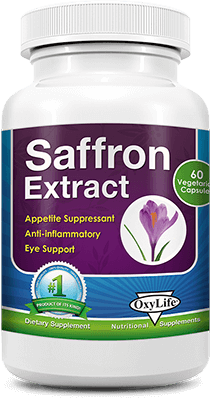
Saffron (60 Veg Capsules) is one of the rarest and most exotic spices found on earth. Saffron is also known as ‘Golden Spice,’ because of its vibrant reddish-golden color. It is used widely in Indian, Mediterranean, and Italian cuisine. This culinary delight grows on a flowering plant — Crocus Sativus — in various countries around the world, including many Asian and European countries. (Areas with hot, dry summers and wet springs are the most suitable areas for growing Saffron.) While Saffron is popular for its flavor, color, and fragrance… this rare spice also offers many health benefits. Saffron is very expensive, mainly because of the fact that 150 flowers are required for making 1 gram of Saffron strands.
According to the USDA Nutrient Database, a serving (100g) of Saffron provides:
- 97% of the adult RDA of Vitamin C
- 85% of the RDA for Iron
- 74% of the RDA for Magnesium
- More than a third of the RDA for Phosphorous and Potassium
- More than 11 grams of Protein
Health benefits of these nutrients:
- Vitamin C is crucial to health, well-known as a natural antioxidant
- Magnesium is necessary, at the cell level, to generate energy
- Phosphorous and Potassium are vital to cell health too
- Protein is a building block for muscle mass
Additional health benefits being studied:
- Cancer: Researchers have studied the potential link between the Crocetin and Carotenoid in Saffron and cancer-suppressing/mutation-preventing capability. Specifically, a joint study between the University of Texas M.D. Anderson Cancer Center and Baylor University Medical Center, established that Saffron is an organ Chemoprotector1; research at the Department of Chemical Engineering at the University of Thessaloniki showed Saffron to be effective in fighting free-radicals (which contribute to early-stage cancer development)2; and a comprehensive study at the federal govermnent’s Laboratory of Experimental Oncology in Mexico established that the Carotenoids in Saffron offer numerous Chempreventive properties3. These studies also support Saffron’s role as an antioxidant and anti-inflammatory agent, which play key roles in healing wounds and burns, as well as treating arthritis3.
- Eye care: Scientists are seeking additional data about the link between Saffron and treating macular degeneration, retinitis pigmentosa, and the effects of harmful UV rays4.
- Fighting depression: Saffron extract has been tested to show its effectiveness being equal to theraputic drugs (such as imipramine and fluoxetine)5, 6.
- Numerous other medicinal benefits, such as a painkiller (stomach, menstrual, and more), weight loss (by controlling serotonin), skin health (it’s used in numerous beauty and anti-aging products), pregnancy (reducing cramps) as it enhances blood flow… and its circulation-enhancing benefits have led to its use as an aphrodesiac (offering the same basic benefit of Viagra) for centuries in the Middle East and Asia7, 8.
- As reported in the journal Nutrition and Cancer, Volume 62, Issue 7, 2010: “Curcumin, the Golden Spice From Indian Saffron, Is a Chemosensitizer and Radiosensitizer for Tumors and Chemoprotector and Radioprotector for Normal Organs,” by Ajay Goel (Gastrointestinal Cancer Research Laboratory, Department of Internal Medicine, Charles A. Sammons Cancer Center and Baylor Research Institute, Baylor University Medical Center , Dallas, Texas) and Bharat B. Aggarwal (Cytokine Research Laboratory, Department of Experimental Therapeutics, The University of Texas M. D. Anderson Cancer Center, Houston, Texas).
- As reported in the journal Phytotherapy Research, Volume 19, Issue 11, 2005: “Radical Scavenging Activity of Crocus sativus L. Extract and Its Bioactive Constituents,” by Assimopoulou, A. N., Papageorgiou, V. P., and Sinakos, Z. (2005), (all of the Organic Chemistry Laboratory, Department of Chemical Engineering, Aristotle University of Thessaloniki, Greece).
- As reported in the journal Experimental Biology and Medicine, Volume 227, Issue 1, 2002: . (2002): “Cancer Chemopreventive and Tumoricidal Properties of Saffron (Crocus sativus L.)” by Abdullaev, F. I (Laboratory of Experimental Oncology, National Institute of Pediatrics, Mexico City, Mexico).
- As reported in the journal Investigative Ophthalmology and Visual Science, Volume 49, Issue 3, 2008: “Saffron Supplement Maintains Morphology and Function after Exposure to Damaging Light in Mammalian Retina” by Maccarone, R., Di Marco, S., and Bisti, S. (all of the Department of Science and Biomedical Technology at the University of L’Aquila, L’Aquila, Italy).
- As reported in the journal Alternative Medicine Review, Volume 16, Issue 1 (2011): “Herbal medicines, other than St. John’s Wort, in the treatment of depression: a systematic review” by Dwyer A.V., Whitten D.L., and Hawrelak J.A. (all from Goulds Naturopathica, Hobart Tasmania, Australia).
- As reported in the book, The Healing Garden, published by Kangaroo Press (1995) by Bailes, M. (Sydney, Australia).
- As reported in the Journal of Medicinal Plant Research, Volume 4, Issue 6 (2010): “Saffron Chemicals and Medicine Usage” by Moghaddasi, M. S. (Anatomical Sciences Research Center, Kashan University of Medical Sciences, Kashan, Iran).
- As reported in the Journal of Psychosomatic Obstetric Gynaecology, Volume 32, Issue 1 (2011): “Herbal treatments for alleviating premenstrual symptoms: a systematic review” by Dante G. and Facchinetti F. (both of the Mother-Infant Department, University of Modena and Reggio Emilia, Modena, Italy).
Reviews
There are no reviews yet.