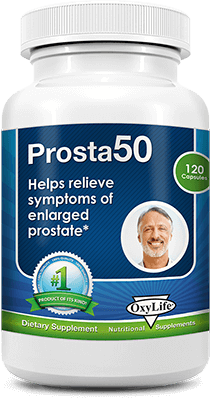
Prosta 50 (120 Capsules)
When a man hits the age of fifity, he needs to start paying attention to areas of his health that he wouldn’t even think about as a younger man. The prostate is one of those areas. Early signs of prostate problems include difficulty urinating, excessive urinating, or pain; these can occur when you have BPH, which is an enlarged prostate. Prosta-50 from OxyLife may help relieve these symptoms by first reducing and then preventing prostate swells that inhibit the urinary tract. Statistics show that 50-60% of men ages 40-60 will suffer from an enlarged prostate; Prosta 50 can be included in a regimen to help prevent this, and eliminate the need for surgery or the onset of prostate cancer: it’s a veritable gardenful of natural ingredients. Just to look at two of them:
According to the USDA Nutrient Database, a serving (50g) of Pumpkin Seed provides:
- 77% of the adult RDA of Magnesium
- 107% of the RDA for Manganese
- 84% of the RDA for Phosphorus
- Nearly 15 grams of Protein
And a serving (100g) of Stinging Nettle offers your body
- 40% of the RDA for Vitamin A
- 43% of the RDA for Calcium
- No fat – zero!
Additional health benefits being studied:
- Reducing prostate swelling: Scientists are searching the world for natural agents that can keep shrink enlarged prostates. The data is encouraging, and numerous plant products head their lists. For instance, a recent university study concluded that key components of Pumpkin Seeds may be beneficial in reducing the size of swelling prostates1.
- Preventing prostate swelling: Of course, prevention (rather than solely focusing on treatment) is also a key for researchers. This parallel yet separate discipline has also uncovered heartening evidence, so in the future the vast majority of men may never have to face an enlarged prostate. Ironically, one solution may be so close to home that’s it’s already found naturally in the human body: Zinc. Many over-the-counter cold-prevention products rely heavily on Zinc — which also acts as a natural antioxidant — newer studies point to its normal biological path to the prostate as potentially offering long-term benefits in regulating that organ2.
- Support for urinary system function: Several of the active ingredients in Prosta 50 are currently undergoing additional research to verify their influence on healthy urinary tract function. Specifically, Saw Palmetto Berry Extract, Pygeum Africanum Bark Extract, and Stinging Nettle are attracting the most interest. A VA study into ways to overcome obstructive and irritative LUTS (Lower Urinary Tract Symptoms) extract of saw palmetto “provides mild to moderate improvement in urinary symptoms and flow measures”3
- Additionally, the National Standard Research Collaboration, in partnership with Harvard University, the U.S. National Institutes of Health, and the U.S. National Library of Medicine, cites results showing that Pygeum “significantly reduces urinary hesitancy, urinary frequency, the number of times patients need to wake up at night to urinate, and pain with urination in men who experience mild-to-moderate symptoms.” 4 And Stinging Nettle has been established as being used for positive outcomes in disorders of the kidneys and urinary tract.5
- As reported in the Journal of Medicinal Food, Volume 9, Issue 2, 2006: “Inhibition of Testosterone-induced Hyperplasia of the Prostate of Sprague-Dawley Rats by Pumpkin Seed Oil” by M. Gossell-Williams, A. Davis, and N. O’Connor (Department of Otolaryngology, Saint Louis University, St. Louis, MO)
- As reported in the Journal of Experimental and Clinical Cancer Research, Volume 28, Issue 84, 2009: “Direct intra-tumoral injection of zinc-acetate halts tumor growth in a xenograft model of prostate cancer” by M. Shah, C. Kriedt, N. Lents, et al (Veterans Health Administration/Center for Chronic Disease Outcomes Research, Minneapolis, MN).
- As reported in the Cochran Database of Systematic Reviews, Volume 3, 2002: “Serenoa repens for benign prostatic hyperplasia.” by T. Wilt, A. Ishani, and R. MacDonald (Veterans Health Administration/Center for Chronic Disease Outcomes Research, Minneapolis, MN).
- Available online, via http://www.nlm.nih.gov
- As reported in the Journal of Ethnopharmacology, June, 2013: “Ethnopharmacological in vitro studies on anti-inflammatory activities of 71 Austrian traditional herbal drugs” by S. Vogl, P. Picker, J. Mihaly-Bison, et al (Department of Pharmacognosy, University of Vienna, Austria).
| Serving Size: | 1 Capsule | |
| Servings Per Container: | 120 | |
| Amount per 1 Serving | % Daily Value | |
| Saw Palmetto | 300 mg | * |
| Pygeum (as Extract) | 20 m | * |
| Stingin Nettle (as Extract) | 100 mg | * |
| Pumpkinseed (as extract) | 50 m | * |
| Zinc (as Gluconate) | 5mg | * |
| Other Ingredients: Gelatin (Capsules) Silica and Magnesium Stearate. | ||
| * Percent Daily Values are base on 2,000 calorie diet. * Percent Daily Value Not Established. |
||
| Natural color variation may occur in this product. | ||
| Store in a cool, dry place after opening. Please Recycle. | ||
| Caution: For adults only. Not for pregnant or nursing women. Consult physician if taking medication (especially anticonvulsants, antidepressants, and those that may affect bleeding time), have a medical condition (including liver disease and coagulation disorders), or are planning to have surgery. Do not exceed recommended dose. Keep out of reach of children. | ||
Reviews
There are no reviews yet.